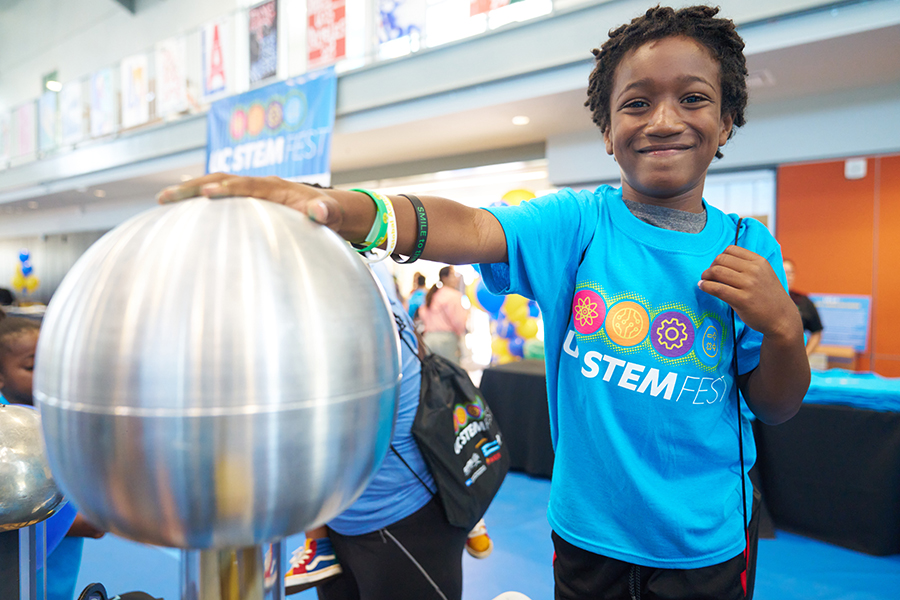
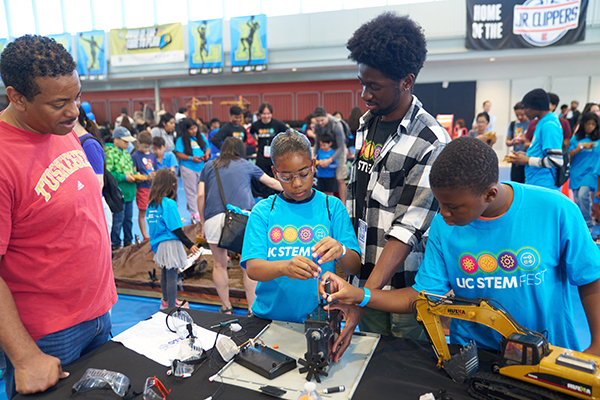
UC STEM Fest introduced children in South Los Angeles to science and technology fields.
By Jason Lewis
For years it has been said that the jobs of the future are in technology. Those future jobs have already arrived. There are more STEM jobs available than there are qualified people to fill those jobs, making college graduates who majored in STEM fields in high demand.
It’s not simple to pick up STEM at an older age in life, but children can soak it up like a sponge. Unfortunately STEM programs are not as prevalent in Black communities as they are in more affluent communities, so UCLA, MESA, STEM Global Action, and the University of California brought UC STEM Fest to South Los Angeles. The event was held at Michelle and Barack Obama Sports Complex (formally known as Rancho Cienega Park). Even though the event has passed, parents can still find local programs to ensure that their children do not miss the tech wave.
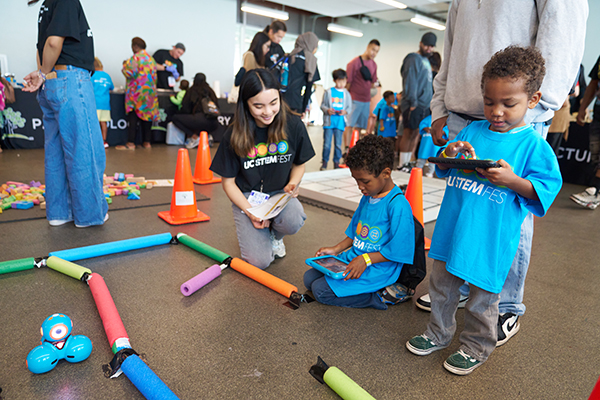
At UC STEM Fest, the students had an opportunity to engage with different STEM activities where they could touch and move things, create a battery operated car that they designed from start to finish, and go into a planetarium where they could see different constellations. They were able to get a feel for exciting career paths that they can take.
“These are the fields of the future,” said Simone Rahotep, senior director at UCLA Strategic Partnerships and Community Engagement. “There is so much science and technology that we see all the time. It’s important that our students and our communities are having access to this information and realizing that these are things that they can do. There’s a huge interest in the STEM field, and they will be creating everything that we will be doing next. They’ll be designing cars, computers, AI. And medical breakthroughs.”
Technology can be intimidating, and the term can mean many different things, which can make it a bit confusing. Events like UC STEM Fest breaks it down so that children can understand it.
“We’re building comfort, interest, and excitement about STEM,” Rahotep said. “When they get to do hands-on activities they recognize that STEM fields are fun. Sometimes people have a preconceived notion that it's hard or boring. Something like the STEM Fest shows that it's actually fun, exciting, and cool.”
As a public university, UCLA serves the entire city of Los Angeles and surrounding areas, so for a free program like this they are meeting people where they are at in terms of location and finances.
“Here in Los Angeles, which is a diverse city, we have a responsibility to be a part of Los Angeles and to bring opportunities and resources to people who have less resources,” Rahotep said. “We want to make things accessible. We should bring things to where they are. You don’t want money to be a barrier to experiences.”
UCLA has held STEM programs in South Los Angeles in the past. UCLA Center X created the Launch Academy, which is a summer program that was held at Bethany Baptist Church in the Crenshaw Manor area. At the summer camp, the children, age 4-14, were not only studying out of books and learning off of a white board. They were performing hands-on tasks that are based on the concepts that they are learning from their teachers. They were building movable objects with materials that can be found just about anywhere, mixing different chemicals, and solving equations.
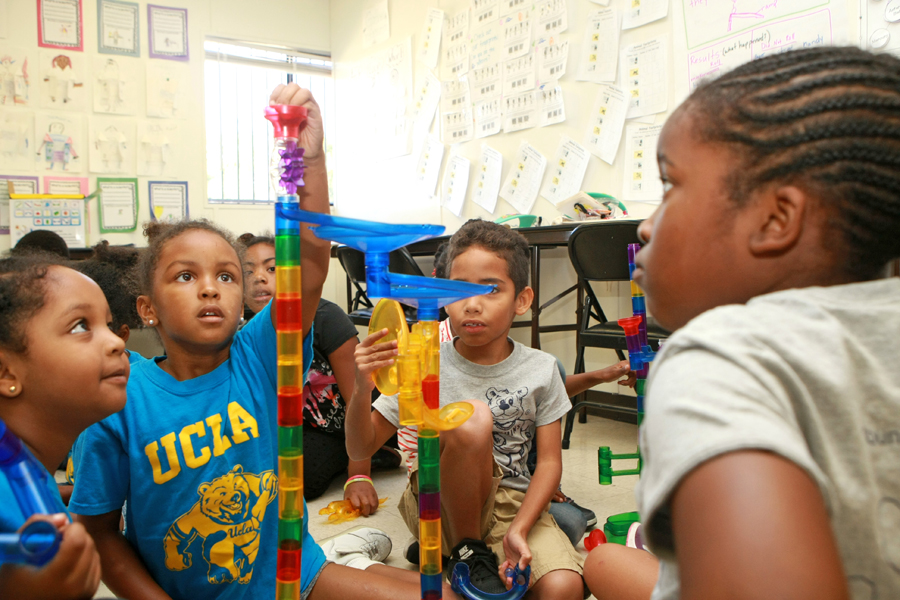
“This is not just about fun, the fun is a byproduct,” said Lynn Kim-John Ed.D., Director of Science Programs at UCLA Center X. “The primary goal is for the kids to learn some science. They’re having fun because they’re engaged in deep conceptional thinking. They feel empowered because they’re learning. How many times do children go to science class and feel defeated because they don’t understand some science concept, and nobody cared enough to ask, ‘do you understand?’”
“This program is important, because our children, African Americans and Latinos, do not get the advantage of STEM programs,” said Michelle Washington, Education Program Coordinator at the Bethany Baptist Church Community Development Corporation. “You see those programs offered in higher (income) areas. This program allows our children to know that they are just as good. That they can be a scientist, a bio-chemist, that they can go into engineering. You can be from (South) L.A., you can be from Compton, you can have one parent in the home, and you can still be involved in those type of things. It’s not just an Asian thing, or a Caucasian thing. It’s an everybody thing.”
UCLA alumni have also created programs to help local children learn about STEM. UCLA grad Jennifer Lashley created South L.A. Robotics and UCLA grad Audrey Thompson is the founder of the Engineer Factory in South Los Angeles.
Lashley founded SoLA Robotics after she took a group of students to a robotics competition at El Camino College. She quickly noticed that her team made up of children of color were the only team in the competition who were from that area.
“This is on Crenshaw Boulevard,” she said. “We’re not talking about way out somewhere. We were the only L.A. team there out of 36 teams, and we were the only Black and Brown team in the room. I’m looking around like, ‘where are the kids who live down the street?’ We found a local competition, but we were the only local team. So the next year we brought five teams with 20 kids.”
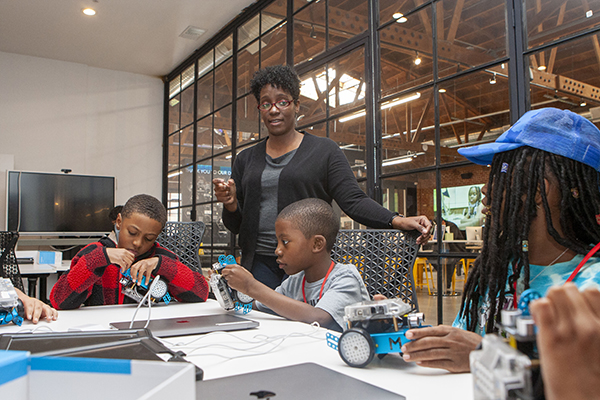
Lashley wanted to provide STEM instruction to students who did not have easy access to it, so should founded SoLA Robotics, which holds classes at the SoLa Technology & Entrepreneurship Center and at the South L.A. Best Buy Teen Tech Center, which is at the Vermont Slauson Economic Development Corporation. She teaches children how to code through building robots.
“With STEM we think about technology, apps, websites, programming, computer science, and things like that,” she said. “The reason why I teach STEM through robotics, or coding through robotics, is because it gives the kids something physical that they can build. You can imagine how much kids love Legos. They love to build it and they love to create new things. Robotics is not that different, but except in this case when they are finished they get to program it to complete a specific task. The way that the programming comes in is that they have to learn a coding language in order to program the robot to do the task. So it’s like a multiple step thing that we’re taking the kids through. They’re learning about engineering, how to communicate, about parts and censors, and they’re learning one or more programming languages. So it’s kind of an all around STEM activity where you’re hitting the science, technology, engineering, and the math through robotics.”
Since the Engineer Factory opened in 2016, they have served more than 9,000 students of color through hands-on workshops.
“The goal is to empower more African American, Latinx, and female students in underserved communities to level the playing field for STEM education,” Thompson said. “Our goal is to expose our students to engineering in particular. My husband and I started the program with the hopes of encouraging more students to pursue engineering in the future.”
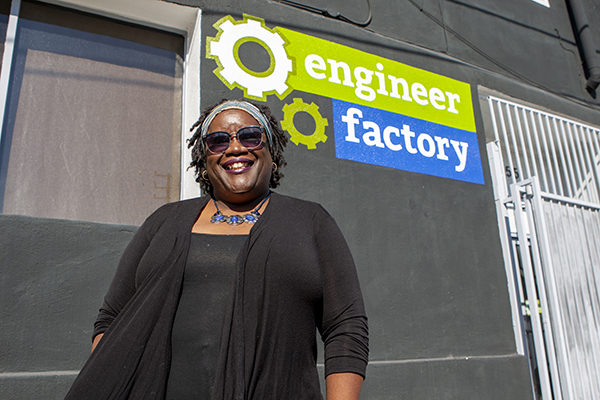
Thompson’s son was interested in engineering when he was a child, but there were not very many programs for him. Luckily at Monroe Middle School in Inglewood, there was a MESA (mathematics, engineering, science, achievement) program which was one of the winningest in California. That program was exactly what Thompson needed to push her son into STEM fields.
“It was challenging for an African American male living in Inglewood to navigate the process to have success in STEM in high school and then ultimately get to college with it,” she said. “Now I’m the proud mom of a working electrical engineer.”
Thompson points out that one issue is that local schools do not offer certain classes that are prerequisites for STEM majors in college. She said that less than 14 percent of schools in underserved communities offer AP computer science, which is a subject covered at the Engineer Factory. Black students who are interested in STEM fields but do not have access to the classes needed typically do not graduate college with degrees in STEM majors.
“A report came out in 2017 that of all of the African American, Latinx, and female students, when they enrolled in college with a STEM major, 65 percent of them changed their major to a non-STEM major within the first two years of college,” Thompson said. “One of the biggest reasons cited by the students for why they would change the major was their lack of confidence in math. We started a summer program to start building up math skills for our students because we are addressing the impediments to success for them to go into these high-paying fields.”
Many K-12 students participate in STEM competitions, which are sponsored by corporations such as Jet Propulsion Laboratory (JPL) and The Aerospace Corporation.
“These competitions seldomly had students of color represented,” Thompson said. “These competitions are often a gateway to getting on the radar of certain colleges.”
For more information about SoLA Robotics, visit www.southlarobotics.com and follow them on social media.
The Engineer Factory is located at 3555 S. Western Avenue. Contact them at (310) 625-3710. Visit their website at www.theengineerfactory.org, and follow them on social media.