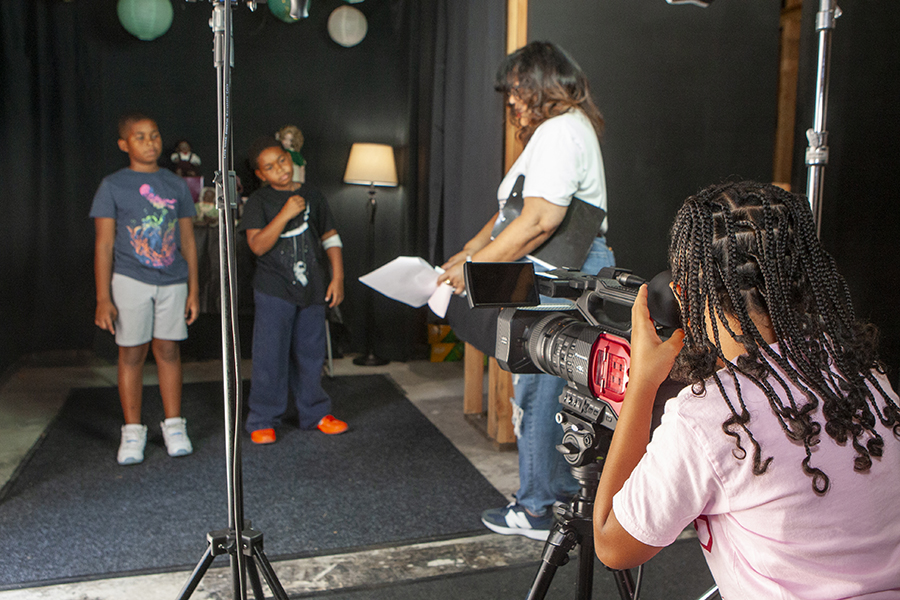
The Inglewood-based foundation has youth classes in film production, directing, scriptwriting, cinematography, and audio production.
By Jason Lewis
The Greater Los Angeles area is traditionally known as the “Entertainment Capital of the World” with 27 percent of U.S. film and television jobs in this area at the end of 2023, according to a report from Otis College of Art and Design. According to a Bureau of Labor Statistics report, three percent of Los Angeles’ workforce is employed within this industry.
Many of Hollywood’s film and TV production studios are within 10 miles of local Black communities, so it makes sense for Black children to be exposed to these professions. With that in mind, producer and director Pamela Bright-Moon launched the Moon Global Foundation, Inc., which holds youth classes in film production, directing, scriptwriting, cinematography, and audio production. The classes are held at Moon Global Studios in Inglewood, on La Brea Avenue just north of Centinela Avenue. Bright-Moon is introducing her students to lucrative fields.
“When you ask kids what do you want to do when you grow up, and you get the traditional doctors, lawyers, firefighters, but nobody says anything about working in TV or production,” Bright-Moon said. “They’re familiar with the video games, movies, and watching YouTube. These are careers. I know people who made careers off of making the sounds effects on “The Prices is Right.” They sent kids to college, bought houses and boats.”
Bright-Moon recently had a group of 2nd through 5th grade students go through the process of taking their visions to the screen. They started off learning the various film genres and then moved on to learning the fundamentals of production.
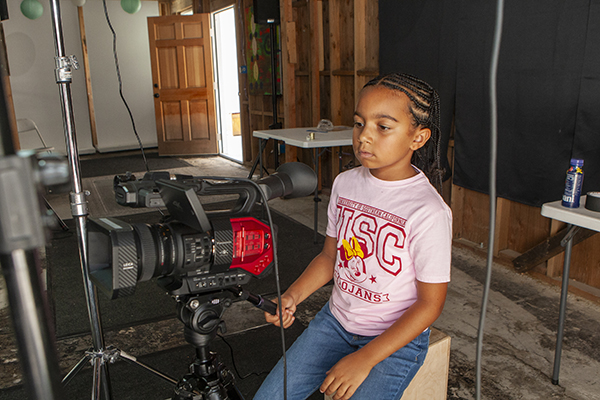
“I want them to understand what they’re watching,” she said. “We go over comedy, adventure, action, horror, and drama. From that process they identify what is their favorite genre. From that point we do story development.”
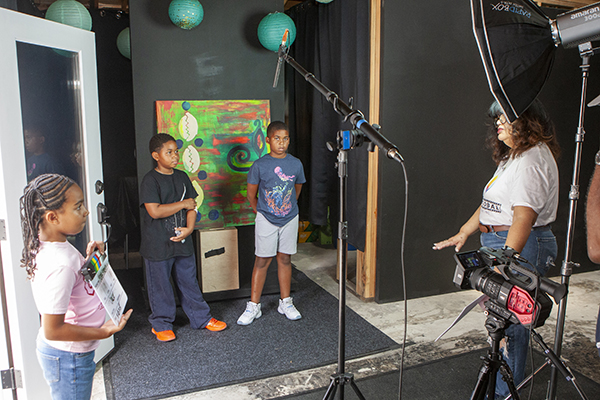
Once the story and characters have been developed, the students start on the technical aspects of production. They learn the basics of the cameras, lighting, audio, and editing.
“We are able to shoot and teach the kids how to shoot the different camera angles,” Bright-Moon said. “We go over the close ups, the medium and the wide shots. We go over lighting; how to get the best dramatic fill or just the best overall look for your lighting. We go over music. We shoot each individual film and then we edit what we shot.”
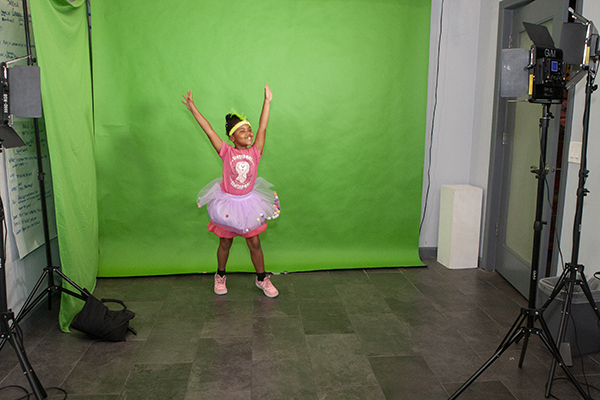
The students enter the program without any production skills, but they quickly learn the concepts of production and how to use the equipment. Bright-Moon also emphasized that these are careers.
“It’s amazing and these kids are just like sponges,” she said. “This is their first introduction to this type of program. They know what they like and what they don’t like, but they don’t know how to make it happen. One of the first things that we do is go to the show credits because we want to make sure that they understand that all of these people are involved in making this production that you’re watching, and that these are jobs that are here in town. We have guest speakers who come in and tell them about how they got their job so that they can really see that the work they’re doing on an introductory level, that with more knowledge and instruction they can have a career working in film and TV in their own town.”
This hands on program uses high-end equipment because that’s what Bright-Moon and other professionals learned on and work with.
After a graduating from Dorsey High School, Bright-Moon received a degree in broadcasting and television from Cal State Los Angeles. After being appointed to the Los Angeles Art Commission, she went back to school to obtain a master’s degree from Azusa Pacific in art history theory and criticism.
Bright-Moon’s first job after Cal State Los Angeles was in the mailroom at CBS Studios on Fairfax Avenue and Beverly Boulevard. Very early in her career she was able to meet people from different departments while she was delivering mail within the studio.
“I knew that I had interest in the technical end of television,” she said. “At that time the majority of the Black people were on the ground floor of CBS in the engineering lounge on breaks between shows. The camera people, lighting, audio, a good portion of the Black employees were in that technical lounge. Me being the ambitious one, I thought that I could do this too. So I was able to get out of the mailroom and into production scheduling. That took me to another level of overseeing what was happening in the studio space. We scheduled stages, equipment, employees, the technical people; anything that went into the production came through our production scheduling department. So I got a great overview and I knew that there were opportunities because I saw that there were people who looked like me in the lounge, on the stages, doing the work. So I decided that I wanted to be an engineer in video tape.”
While Bright-Moon was influenced by Black people on the job, she did not see very many of them, especially Black women. That led her to creating her youth program.
“Throughout my career there were maybe three or four Black women between the editors and those that worked in video tape that worked with me, and there weren’t very many Black people,” she said. “One of my goals before I retired was that I wanted a person of color to take my place. During my last 20 years, I was the only woman in satellite transmission. I hadn’t seen very many Black people that were being hired, and those that were there were aging out. It’s such a good field and great career that I wanted to expose youth to it.”
For more information about this program, visit www.moonglobalfoundation.org and follow the program on social media.